The Thermal Envelope of Handheld Enclosures
Desktop and laptop computers operate with generous thermal envelopes, exhausting dozens or hundreds of watts through large fans and fin stacks. A handheld console operates in your palms. It is physically constrained by human tactile tolerance and strict international safety regulations. No matter how powerful a processor is embedded on the mainboard, the maximum sustained power consumption of a handheld device is dictated by how many watts of heat it can reject into ambient air without scalding the user.
Under international standard IEC 62368-1 (Audio/video, information and communication technology equipment), the maximum allowable touch temperature for non-metallic handheld surfaces held continuously is 48.0°C. For metallic surfaces, the threshold drops to 43.0°C due to metal's higher thermal effusivity. This boundary establishes a hard physical limit: if a passive aluminium or plastic enclosure reaches 48°C, the operating system thermal governor must aggressively throttle clock frequencies, regardless of what the user is doing.
Passive Cooling: The Thermal Saturation Curve
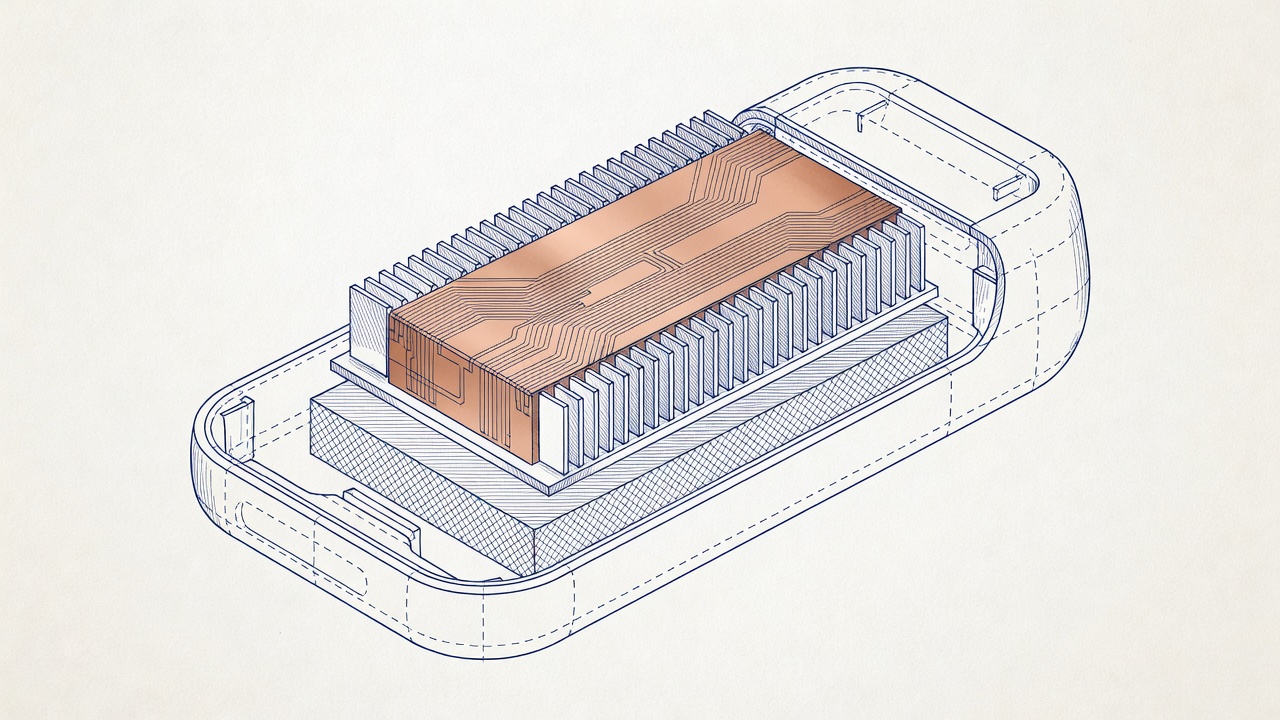
Low-cost and pocket-sized handhelds frequently dispense with fans, relying exclusively on passive thermal management. This setup consists of a silicon thermal interface material (TIM), an aluminium or copper heat spreader sheet, and a graphite foil path distributing heat to the rear plastic shell or display backplate.
Passive cooling works efficiently for bursty workloads, such as opening an application or parsing a game menu. However, when running an emulator that demands continuous 2.0 GHz CPU cycles, the thermal capacity of the internal heat spreader saturates within 5 to 10 minutes:
- Phase 1 (Transient Warmup): Silicon temperature rises from 30°C to 65°C. Heat flows into the copper plate. Device shell remains cool. Full performance is maintained.
- Phase 2 (Thermal Saturation): The internal metal spreader reaches thermal equilibrium with the chassis. Heat transfer slows because the temperature delta between the internal plate and the outer plastic narrows.
- Phase 3 (Governor Clamp): To protect the battery pouch and meet touch thresholds, the kernel trips its thermal zone trip-points (often set at 70°C or 75°C die temperature). The governor slices core clocks in half, dropping from 2.0 GHz to 1.1 GHz instantly. Audio stutters violently and frames drop below 30 FPS.
Lithium-ion polymer batteries age rapidly when exposed to heat. Operating a pouch cell above 45.0°C accelerates electrolyte oxidation and capacity loss. In poorly designed passive handhelds, the heat spreader sits directly against the battery wrapper, baking the battery under normal gameplay.
Active Dissipation: Radial Blowers and Vapour Chambers
To sustain power dissipation above 5 Watts indefinitely, an active cooling system is mandatory. A miniature centrifugal blower draws air through intake grilles, pushes it across a dense copper or aluminium micro-fin array, and exhausts hot air out the top edge away from the player's fingers.
By forcing convective heat transfer, active cooling maintains a steep temperature gradient across the heat pipe or vapour chamber. The silicon die can operate steadily at 65°C to 70°C while the exterior grip surfaces remain below 36°C. This guarantees that the processor never encounters governor trip-points, maintaining identical frame pacing at hour four as it achieved at minute one.
| Cooling Topology | Maximum Sustained TDP | Typical Die Temp (Load) | Time to Thermal Throttle | Acoustic Footprint |
|---|---|---|---|---|
| Passive Graphite / Copper Foil | 2.5 W to 3.5 W | 72°C to 85°C | 6 to 12 minutes | 0 dBA (Completely Silent) |
| Passive Cast Aluminium Chassis | 4.0 W to 5.0 W | 68°C to 78°C | 15 to 25 minutes | 0 dBA (Conductive Chassis) |
| Active Heatpipe + Micro-Blower | 8.0 W to 15.0 W | 60°C to 70°C | Infinite (Sustained) | 28 to 38 dBA |
| Active Dual-Pipe Vapour Chamber | 18.0 W to 30.0 W | 62°C to 72°C | Infinite (Sustained) | 32 to 44 dBA |
Evaluating Thermal Claims
When reviewing manufacturer specifications, treat published burst clock rates with healthy scepticism. Look for sustained power metrics (often labelled as PL1, cTDP, or continuous thermal dissipation limits). A 1.8 GHz processor that runs indefinitely without throttling delivers an infinitely superior gameplay experience compared to a 2.4 GHz chip that throttles down to 900 MHz after ten minutes of intense emulation.